
Some of these technologies are already arriving on South African farms. Others are still expensive or experimental, although many experts believe they will become more common over the next decade.
Technology is advancing at a pace agriculture has rarely experienced before. The sheep and windpumps that define the Karoo vista are unlikely to disappear by 2035, but they could increasingly work alongside autonomous machinery and sensors that can detect problems long before they become visible to the human eye.
Some of these technologies are already arriving on South African farms. Others are still expensive or experimental, although many experts believe they will become more common over the next decade.
Artificial intelligence becomes the farmer's assistant
While artificial intelligence is often discussed as replacing people, agriculture is taking a different path. AI is becoming another source of advice. Modern software can already combine weather forecasts with satellite imagery as well as soil moisture measurements, livestock records and market prices to recommend the best time to move livestock or apply fertiliser.
Researchers expect these systems to become more accurate as they learn from years of farm data. AI might come to strengthen existing experience by helping farmers recognise patterns sooner. The technology is already being integrated into precision agriculture platforms around the world, with applications expanding rapidly.
Eyes in the sky
Satellites have become one of agriculture's most powerful tools. What began as simple aerial photography has evolved into sophisticated monitoring systems capable of estimating pasture growth, vegetation stress, soil moisture and even grazing pressure across thousands of hectares.
This could mean identifying camps under pressure before livestock condition begins to suffer, especially for a Karoo farmer managing extensive veld. Satellite data combined with Artificial Intelligence may soon forecast forage shortages weeks in advance, allowing farmers to respond earlier during drought conditions.
As such, more researchers consider satellite remote sensing as one of the foundations of modern precision agriculture.
Smarter livestock
GPS-enabled collars and electronic ear tags are also more sophisticated. Some systems already monitor an animal's grazing behaviour and water visits. Others can alert farmers when an animal appears ill or is close to calving.
Another impactful development is virtual fencing. Instead of building kilometres of conventional fencing, livestock wear GPS collars that recognise invisible boundaries programmed into a computer. As an animal approaches the boundary, the collar emits an audio signal followed, if necessary, by a mild electrical stimulus. The virtual fence can be moved with a few clicks, making rotational grazing far more flexible while reducing fencing costs. Although still emerging, the technology has shown promising results in Australia and New Zealand.
Drones that do more than take photographs
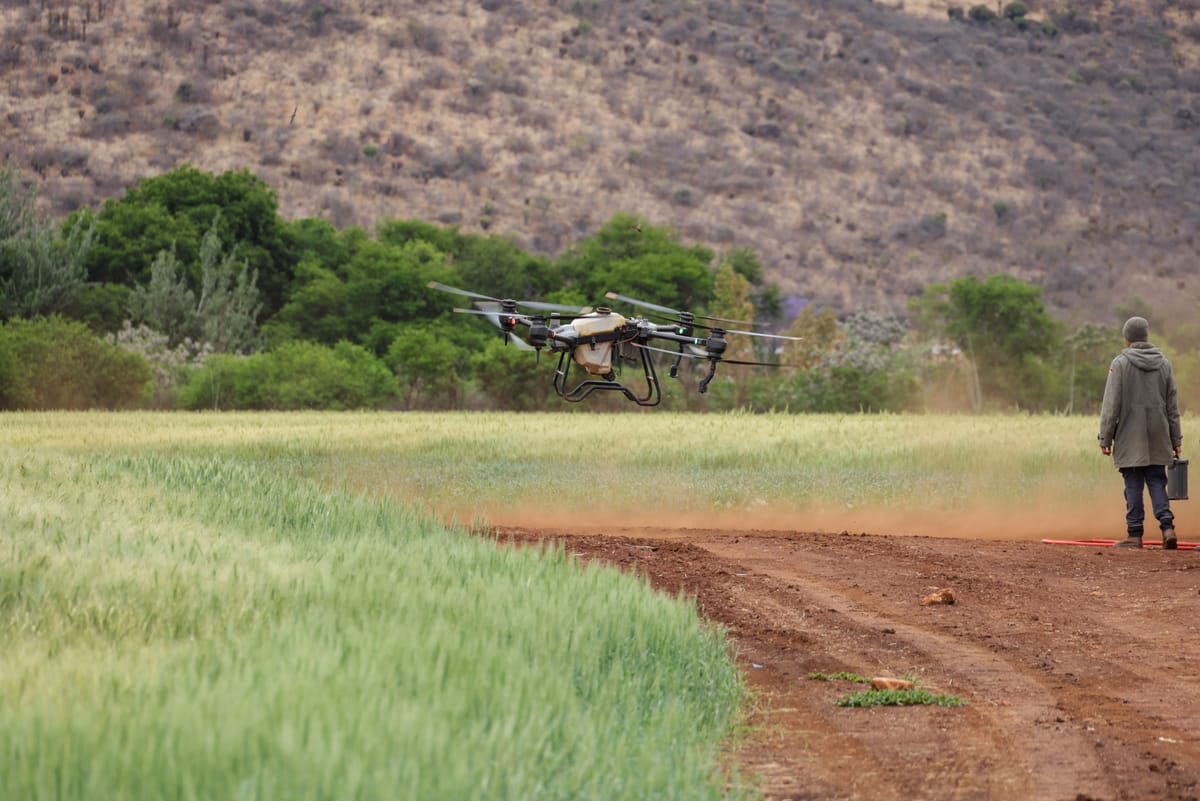
Modern agricultural drones can inspect fences, monitor water infrastructure, identify crop stress and even spray crops with precision.
Researchers are also developing drones equipped with artificial intelligence capable of recognising weeds and identifying disease outbreaks automatically. On large Karoo farms, where checking distant camps can take hours by vehicle, drones have the potential to save both time and fuel while improving the speed of decision-making.
Machines that drive themselves
Fully autonomous tractors still sound futuristic, but they are already operating on farms in North America and Europe.
Using a combination of GPS, cameras, radar and onboard computers, these machines can cultivate and spray fields with minimal human supervision. While their high cost means widespread adoption in South Africa is likely to take time, automation is expected to become more common amidst growing efficiency pressures.
The same trend extends to smaller robotic machines capable of removing weeds mechanically or using lasers rather than herbicides. These technologies could become attractive over the coming decade for vineyards and high-value crops.
The next generation of efficient farming
A satellite cannot understand decades of experience, while artificial intelligence cannot yet match the instincts of a farmer who has watched the same veld through countless seasons.
What these technologies can do is provide more precise management tools. By 2035, the Karoo might still look comfortingly familiar from the road, while the farming beyond the fence is likely to be more connected and data-driven than ever before.
 Liz Thorne
 Mariana Balt
 Lynette Spencer
Comments ()