

The Karoo Winter Wool Festival revealed that, with the right skills and access to markets, wool's role as the region's high value product can begin to extend beyond the farmer's gate and into the communities these farms sustain.
The Karoo Winter Wool Festival may be a celebration of natural fibres, but its fifth edition also showcased that wool does not have to leave the countryside as a raw commodity.
Held at Dwarsvlei Farm near Middelburg from 3 to 4 July, the 2026 festival brought farmers, processors, designers, artisans and consumers into one space. Exhibitions and workshops demonstrated how wool moves from a sheep’s back into yarn, clothing, bedding, décor and skincare products.
Rediscovering this full journey is vital for small towns in a region that already produces a valuable raw material. The larger opportunity lies in retaining more of the work and income created after the sheep has been shorn.
Closing the gap between farm and finished product
One of the festival’s central aims was to address the disconnect between wool producers and the products eventually made from their fleeces.
Festival organiser Sarah van Lingen told sustainable-design publication Twyg that farmers sometimes have little idea what becomes of their wool after it is sold. By placing shearing, wool handling and classing alongside spinning, weaving, fashion and retail, the festival brought the different parts of the value chain back together.
This created a visible roadmap of the economic journey in which fleece from a Karoo farm is only the beginning. Every additional step represents employment and income, but much of that value is currently created outside the towns and farming districts from which the wool originates.
A market for small manufacturers
The festival’s Natural Fibre Market gave local and South African manufacturers an opportunity to sell directly to people already interested in wool, mohair and other natural materials.
Confirmed 2026 exhibitors included Luminous Ware, Gerber & Co, Adéle’s Mohair, Quenti Alpaca and Helderstroom Alpacas. These businesses demonstrated several different ways in which raw fibre can support viable manufacturing.
Luminous Ware produces Merino wool and mohair clothing in Cape Town through specialist manufacturers and hand-knitters. The brand's presence showed how natural South African fibres can be turned into contemporary knitwear rather than treated solely as agricultural exports.
Adéle’s Mohair presented a different model. The company operates as a labour-intensive cottage industry, producing designer accessories and home textiles from locally sourced mohair and Merino wool. The company also has a shop in Graaff-Reinet, creating a direct connection between fibre production and Karoo tourism.
Quenti Alpaca and Helderstroom Alpacas extended the discussion beyond sheep’s wool. These businesses process alpaca fibre into yarn and finished products, showing how small farms can move beyond breeding animals to manufacture goods of their own. At Helderstroom Alpacas, fibre is cleaned, carded and spun before being knitted, woven or felted. Local women have been trained in hand-spinning and help produce the farm’s finished garments.
From cottage industry to commercial processing
Gerber & Co represented the more industrial end of the local manufacturing opportunity. The company works across multiple stages of the South African wool chain, from raw material to finished Merino products. Their approach demonstrates how local garment production can narrow the distance between farmers and retailers.
The International Wool Textile Organisation has previously described Gerber & Co as a rare example of a vertically integrated Merino business. Their production model has included local carding and dyeing, followed by final knitting performed by community-based makers.
This is important because rural manufacturing does not have to choose between individual artisans and large factories. Small makers can supply or work with larger processors, while established manufacturers can provide access to equipment and markets that cottage industries cannot easily reach alone.
Teaching the skills behind the products
The festival's workshop programme allowed visitors to learn some of the skills needed to make them. Sessions covered spinning, weaving, felting, knitting, natural dyeing and working with raw fleece. Other workshops explored lanolin-based skincare and wool used in décor.
The festival planned up to 12 workshops per day, with small groups intended to give participants practical experience. Demonstrations covered skills such as hand-spinning and basic knitting or crochet. This knowledge-sharing function may be one of the festival’s most valuable contributions.
A market provides income for existing artisans, but training creates the possibility of new ones. A person does not need to establish a full textile mill to participate in the wool economy. A home-based enterprise might begin with hand-dyed yarn, felted products, knitted garments or locally made homeware.
With suitable training and access to buyers, several small producers could also work together under one regional brand.
Design gives wool greater value
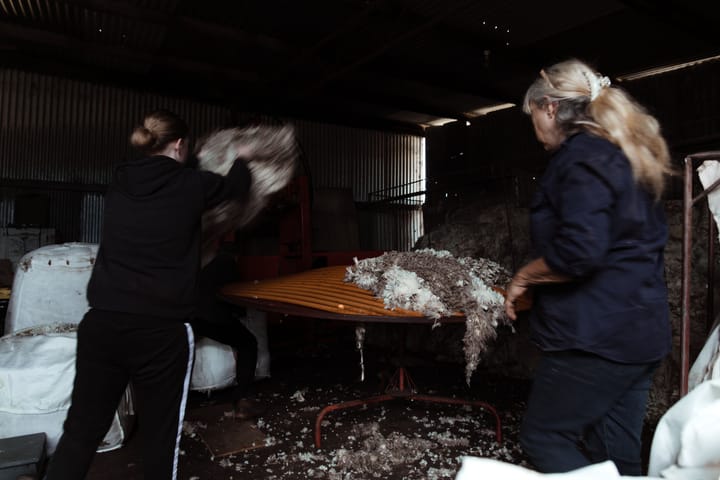
The Karoo Kraal exhibition, curated by Viviers Studio, transformed a working shearing shed into a fashion and design space celebrating natural fibres. This placed design within the wool value chain rather than treating it as something separate from agriculture. A fleece has value, but that value increases when the material becomes a distinctive product.
Design also helps South African manufacturers compete on something other than price. Small rural producers are unlikely to manufacture more cheaply than large overseas factories. They can, however, offer skilled handwork of traceable materials and products connected to a specific region and community.
Bringing more of the value chain home
The festival showed that the foundations of rural fibre manufacturing already exist. South Africa has farmers producing high-quality wool and small businesses successfully turning natural fibres into marketable products.
However, many of the manufacturers showcased at Middelburg are based elsewhere in South Africa. For a few days, the full value chain was brought into the Karoo, but much of the permanent processing still takes place outside the region.
The next question is whether the festival can inspire year-round training and small production businesses in Karoo towns themselves. The region does not necessarily need one enormous textile factory. A network of skilled workers and small manufacturers could begin retaining value at a more manageable scale.
The Karoo Winter Wool Festival revealed that, with the right skills and access to markets, wool's role as the region's high value product can begin to extend beyond the farmer's gate and into the communities these farms sustain.
 Liz Thorne
 Anchen Coetzee
 Mariana Balt
 Anchen Coetzee
Comments ()