
The irrigation channels that made Prince Albert bloom in the desert
Prince Albert may sit in the heart of the Karoo, but its gardens and orchards have thrived for generations thanks to a historic network of irrigation furrows that channel mountain water through the village, a remarkable example of traditional water sharing in South Africa.

Prince Albert is located at the foot of the Swartberg mountains, surrounded by the dry sweep of the Great Karoo. It would appear unlikely that a flourishing village could exist in such an arid place. Rainfall is sparse and the surrounding veld is almost lunar in its dryness.
Behind the town's unlikely green gardens and shady streets, however, is a remarkable piece of historical ingenuity. The answer is water, carefully captured and shared through a network of historic channels that have sustained the town for nearly two centuries.
A desert settlement with a water plan
Prince Albert was formally established in 1842 on land known as Queekvallei. Settlers quickly recognised both the potential and the limits of the environment. The Swartberg mountains offered reliable seasonal water through streams and springs, but the plains below were unforgivingly dry.
Early residents realised that survival would depend on careful management of mountain runoff. Rather than allowing water to disappear into the dry plains, they constructed a network of gravity-fed irrigation furrows known locally as leiwater.
These channels carried water from mountain streams into the village and surrounding agricultural plots. The resulting system, now known as the Prince Albert irrigation channels, became the backbone of the town’s agricultural life. Without it, fruit trees, vineyards and vegetable gardens would never have taken root in the desert soil.
Engineering guided by the mountains
The irrigation system relies primarily on water flowing from the Swartberg range through the Dorpsrivier and several smaller streams. Early farmers diverted this water into carefully cut channels that followed the natural contours of the land.
These furrows were simple in design but remarkably effective. Builders used stone lining and earthen banks to guide the flow, allowing gravity to do the work without the need for pumps or mechanical systems. Water travelled steadily downhill from the mountain slopes into the town.
This Swartberg water system allowed households to irrigate orchards, vegetable gardens and small agricultural plots while maintaining enough supply for neighbouring properties. Over time the system expanded into an intricate web of channels threading through streets and gardens.
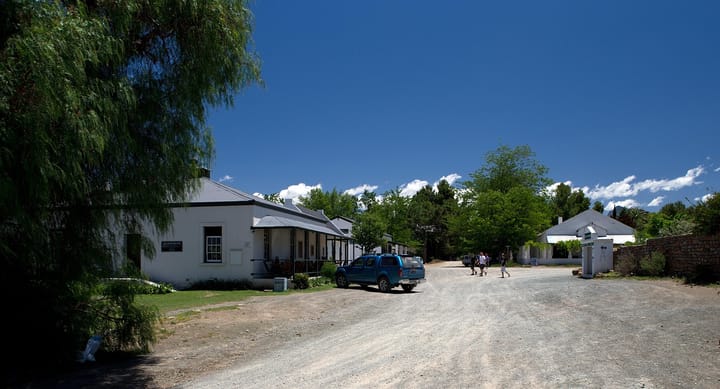
Many of the original routes are still visible today. Narrow streams of water slip past whitewashed cottages while fruit trees lean over the flowing channels. The design is both practical and beautiful.
Sharing water through tradition
Technology alone did not sustain the irrigation network. Community rules and cooperation played an equally important role. Water distribution in Prince Albert follows a traditional time-sharing system known as leiwater irrigation. Residents receive allocated time slots during which water flows through their garden channels. When their turn ends the water is redirected further along the network to the next property.
This arrangement has been maintained for generations through a water committee responsible for managing schedules and maintaining the channels. The approach reflects a practical understanding of scarcity whereby water is treated as a shared resource that must be managed collectively.
From survival to flourishing agriculture
Once the irrigation channels were established the transformation of Prince Albert began almost immediately. Fruit trees, vineyards and vegetable gardens flourished where previously only hardy Karoo shrubs survived.
Apricots, figs, olives, almonds and grapes became staples of the local agricultural economy. Small farms and household gardens supplied fresh produce while surplus harvests were traded with neighbouring towns.
The irrigation system also contributed the character of the village itself. Streets were planted with trees that thrived on channel water, creating shaded avenues unusual for Karoo settlements. Gardens became lush spaces filled with roses, pomegranates and citrus.
The contrast remains striking today. Just beyond the town’s boundaries the Karoo stretches out in muted browns and greys, while inside Prince Albert greenery flourishes thanks to water flowing through its historic furrows.
A heritage system still alive
Few towns in South Africa still operate traditional irrigation systems in the way Prince Albert does. The channels have survived droughts, floods and changing agricultural practices while continuing to serve the community.
Conservation efforts in recent decades have helped preserve the network as both a practical system and a cultural landmark. Residents recognise that the furrows are part of the town’s identity as well as its agricultural lifeline. Visitors walking through Prince Albert often notice the small streams before they understand their significance. Water runs along garden edges, slips under footbridges and murmurs through shaded streets.
Prince Albert may sit in the desert but thanks to its historic irrigation channels it remains a place where gardens bloom.



Comments ()