
The ancient underground life of Karoo termites
Some of the Karoo’s most important environmental work is performed in darkness as, beneath the shrubs and stones, millions of termites rebuild the ground.
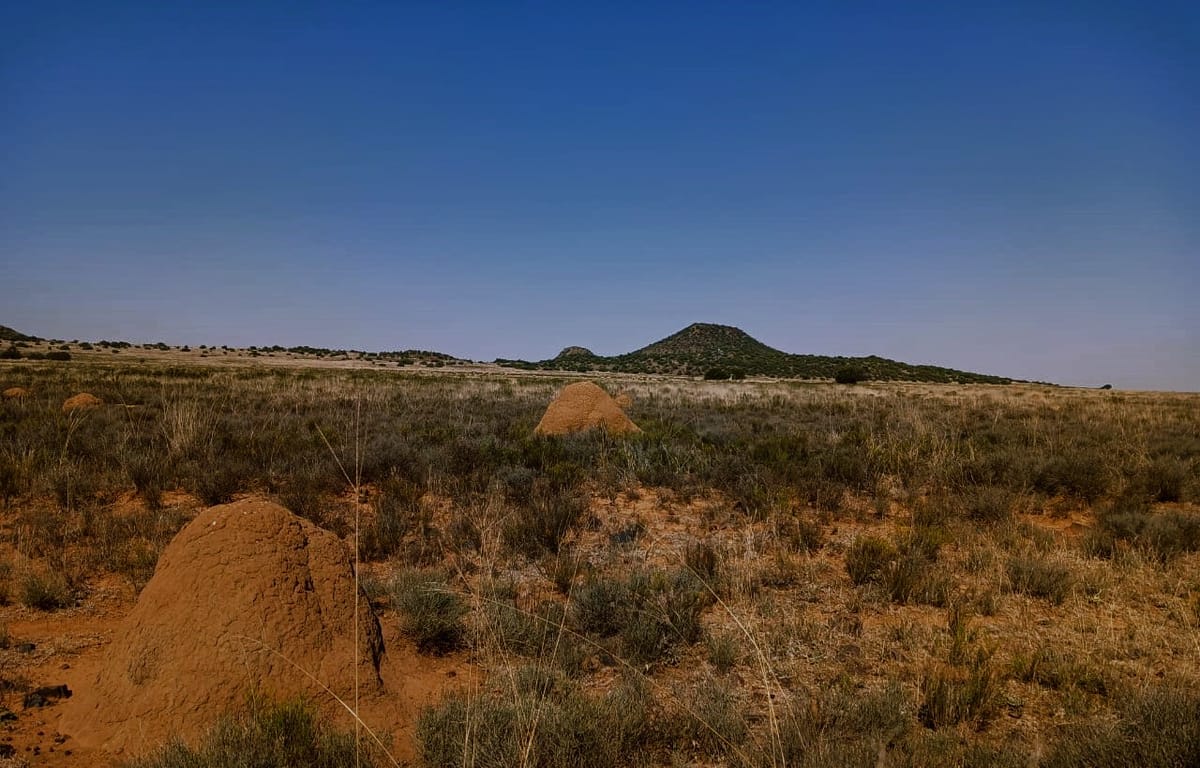
The Karoo seems quiet above ground, but beneath the soil thousands of small workers are carrying plant fragments and remoulding the earth grain by grain. Termites rarely receive credit for this work. Most people notice them only when they damage timber or appear in winged swarms after rain.
In natural veld, however, termites are recyclers, builders and an important source of food. Their underground colonies can alter the soil for generations, creating fertile patches in a region where nutrients and water are often scarce.
Some colonies even occupy structures older than human civilisation.
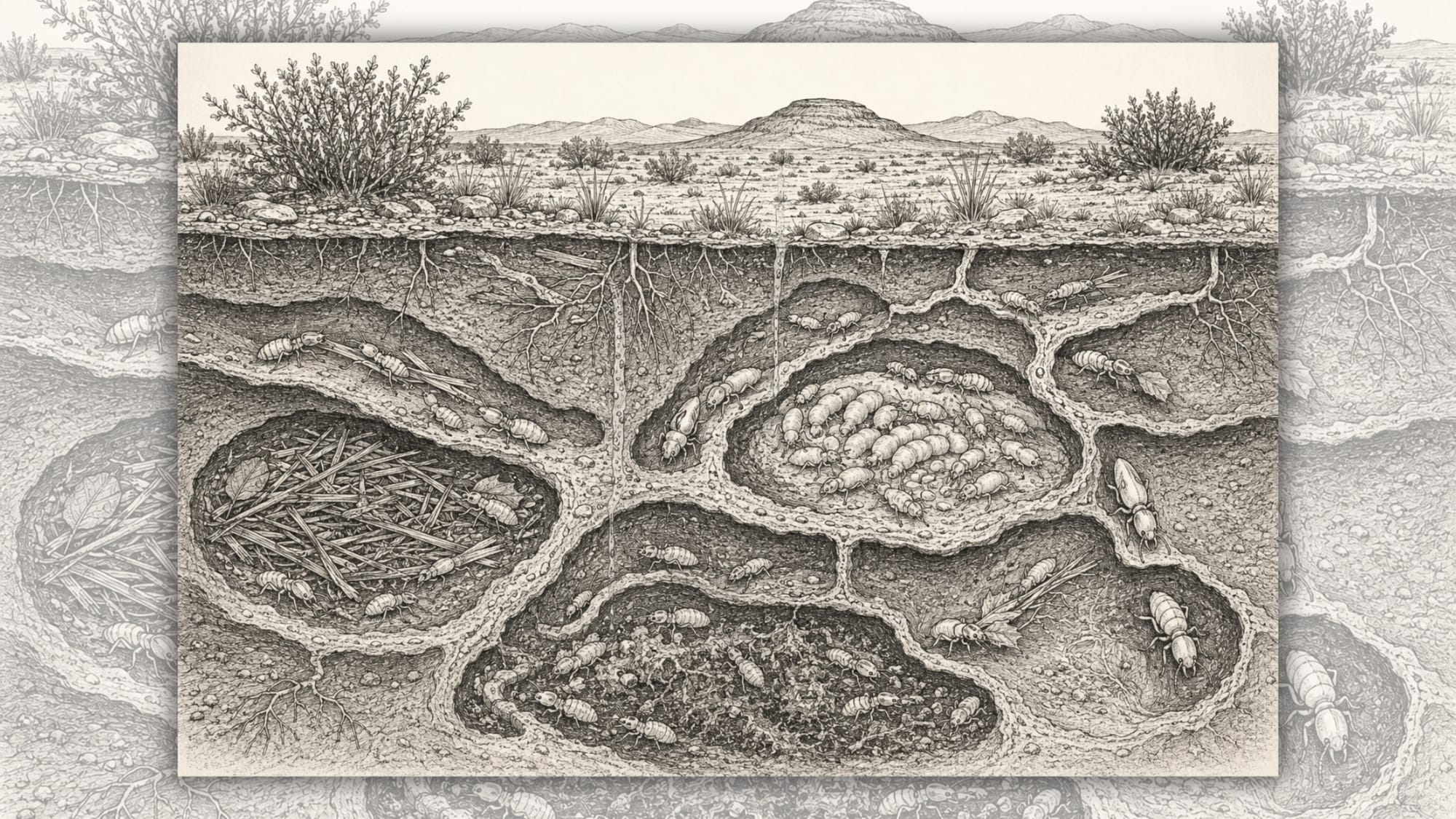
A city beneath the veld
Termites are social insects, although they are not ants. A colony usually contains a reproductive queen and king along with workers, soldiers and young termites. Each group performs a different role.
Workers gather food and maintain tunnels. Soldiers protect the colony, while winged reproductive termites leave established nests at certain times to form new colonies. Most of this activity is hidden below the surface.
Different species live across the Karoo. Harvester termites collect grass, twigs, leaves and other plant matter, then carry it through a network of underground passages. The material becomes food for the colony while its remains, along with termite waste, are mixed into the surrounding earth.
This makes Karoo termites part of the region’s natural recycling system. Dry stems which might take years to break down on the surface are collected and processed underground, returning some of their nutrients to the soil.
Small workers that move the ground
Termites are often described by scientists as ecosystem engineers. The term means that an organism changes its environment in ways that affect many other species. Their tunnels loosen and mix different layers of soil. Fine material can be brought upwards, while plant fragments and organic matter travel down. The resulting channels also influence how water enters the ground.
Research in semi-arid southern Africa has found that termite passages can increase the depth of water infiltration under certain soil conditions. The effect is not identical everywhere because sandy and loamy soils respond differently. Even so, the tunnels can give rainwater a route below a dry or compacted surface.
Karoo rain frequently comes in short, intense bursts. Water that moves into the ground can be available to roots and soil organisms for longer. The colonies also create unevenness in soil fertility. Termites concentrate nutrients around nests and frequently used areas. These patches can support different plant communities from the surrounding veld.
The mystery of the heuweltjies
The work of the southern harvester termite, Microhodotermes viator, in the western parts of South Africa is linked to low, rounded mounds known as heuweltjies. These “little hills” occur across parts of the Succulent Karoo, Nama Karoo and fynbos regions.
Scientists have debated exactly how the mounds formed and how much of their present shape can be attributed directly to termites. The relationship appears to involve not only nest building, but also windblown sediment and long periods of soil development.
A study published in the Journal of Arid Environments found that the establishment of a termite colony can create a nutrient-rich island. Denser vegetation then grows on the altered soil, trapping windblown material and helping the mound expand.
Recent research strengthens the idea that termites continually move elements through this area. A 2025 study of heuweltjie systems found that southern harvester termites bring various plant parts into their nests, supplying calcium, sodium and organic matter which contribute to differences between mound soil and the surrounding ground. These termite mounds are small centres of fertility. Plants grow more densely or produce more flowers on them, while the altered vegetation attracts insects and other animals.
Colonies older than history
The most fascinating evidence comes from Namaqualand, within the Succulent Karoo. Researchers used radiocarbon dating to study heuweltjies along the Buffels River and found carbonate deposits reaching back as far as 34,000 years.
Nature reported that these are the oldest known inhabited termite mounds. The ancient structures are still occupied by southern harvester termites. This doesn't mean that one queen or an unchanged colony has survived for 34,000 years. Generations of termites have continued using and modifying structures built upon the work of earlier colonies.
The mounds also preserve carbon. Plant material carried underground adds organic carbon at depths where it can remain stored for long periods. Water moving through the mound interacts with minerals and calcium carbonate, giving scientists new clues about soil formation and natural carbon storage in dry regions.
A food supply after dark
Termites also support an entire web of predators.
The aardwolf is one of the most specialised. Despite its hyena-like appearance, the aardwolf eats mainly termites rather than large prey. One termite species, Trinervitermes trinervoides, can make up more than 90% of the aardwolf’s diet in South Africa.
Bat-eared foxes also search for termites and other insects. Research conducted near Beaufort West found that insects and wild fruit were important in their diet at Karoo National Park, while foxes on a nearby sheep farm ate a higher volume of termites. The study published in Koedoe suggested that this reflected differences in local food availability.
The connection reaches much smaller hunters. Research at a Karoo site near Prince Albert documented specialised sand-diving spiders living around colonies of Microhodotermes viator. These spiders prey so heavily on termites that the relationship determines where they occur. Birds, reptiles and other insect-eaters also take advantage when winged termites emerge, briefly turning an underground food source into an above-ground feast.
A hidden workforce
Termites can cause real losses when they get into buildings or stored timber. That problem shouldn't be confused with their ecological role in open veld. Healthy natural colonies clear plant material while moving nutrients, building the soil structure and feeding other species. Their work creates pockets of biological activity beneath a region that looks empty.
As such, some of the Karoo’s most important environmental work is performed in darkness as, beneath the shrubs and stones, millions of termites rebuild the ground.
 Lynette Spencer
 Mariana Balt
 Liz Thorne
 Charlotte Hayes



Comments ()