
How the Sunday roast became a South African ritual
The decision to continue the tradition still gives the tired week its magic. In a Karoo kitchen, this could begin with lamb and a pan of potatoes and still be underway when the cook finally sits down, someone passes the gravy and asks for a second helping.
In A Christmas Carol, the streets fill with people carrying their dinners to bakers’ shops. The food disappears into the ovens as the church bells ring. For poorer families without ovens of their own, a special meal needed a borrowed kitchen.
Published in 1843, the novella makes this disparity explicit in a pointed exchange about depriving poor people of their means of dining every seventh day. A household might afford the ingredients for Sunday lunch without having ovens or fuel. Behind the warm walls of the bakery was something wealthier families could take for granted: an oven large enough for the dinner with heat enough to cook it and somebody to tend the meat.
The Sunday roast is wrapped in memories of family, but the history of this pleasant tradition revolves around affordability: who could buy meat with the means to cook the roast and how a household made one major purchase serve more than one purpose.
These British socio-economic questions met local realities in South Africa. Beef gave way to lamb, and a British-style roast shared a plate with rice, sweet pumpkin or beetroot. The recognisable tradition assumed the habits of another world.
Before the oven timer
Popular accounts date the Sunday roast to Tudor England, when roast meat was already associated with wealth and generous hospitality. Historic Royal Palaces describes freshly roasted meat as an everyday privilege of higher-ranking Tudor courtiers. The kitchens at Hampton Court served an elaborate hierarchy, and certain foods denoted rank.
Roasting also needed labour. Before a joint could be left in a thermostatically controlled oven, meat turning on an open fire needed constant attention.
One surviving witness is a wooden dog wheel at the George Inn in Lacock, documented by the National Trust. A specially bred turnspit dog ran inside the wheel, driving a chain connected to the spit. Low-ranking kitchen servants did the turning before the use of these somewhat imaginative mechanisms.
The later British Sunday meal made roasting a weekly staple. Churchgoing, a day of rest, gave the meal a special place. But the attractive story of every family leaving a joint in the oven before church smooths over enormous differences in income and kitchens. Dickens’ borrowed ovens paint an uneven picture.
A Cape roast could come out of a pot
British occupation and settlement provided an important channel for British food habits in South Africa - but roast was introduced to a country where cooks already had their own ways of preparing meat.
Hildagonda Duckitt’s Hilda’s “Where Is It?” of Recipes, first published in 1891, has one example of this integration.
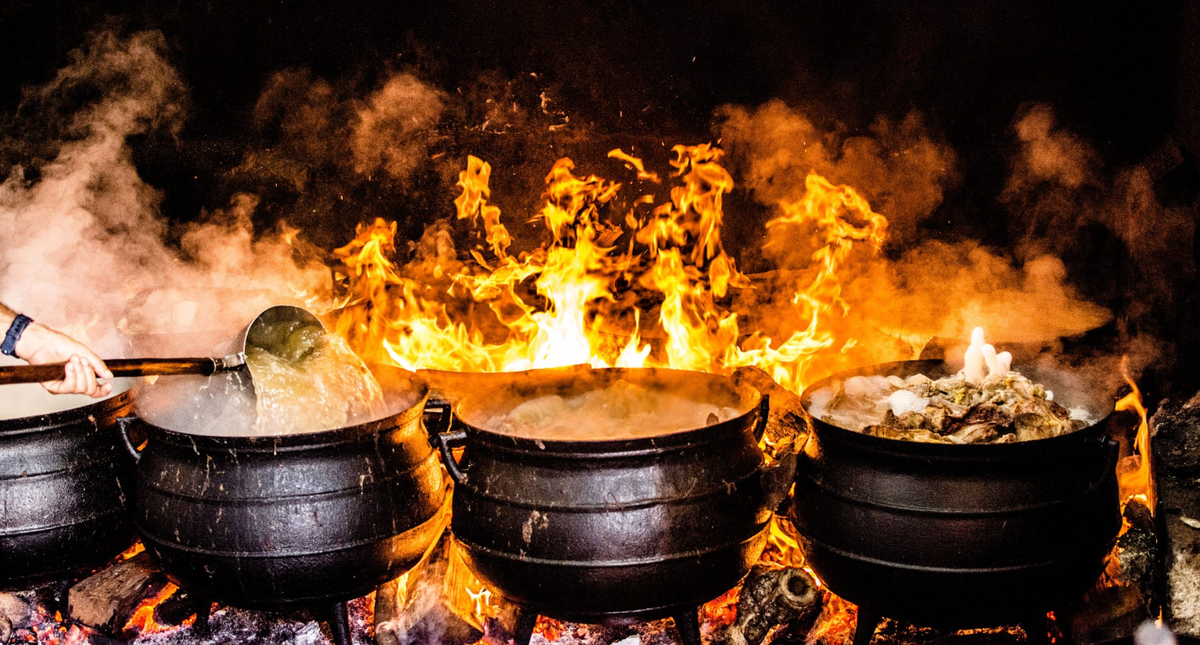
In her introduction, she credits old Cape families of Dutch descent who had Malay and Indian cooks with understanding roasting. Their method used a shallow, round Dutch baking-pot with a raised lid. The meat began with a little water and heat; live coals were subsequently placed on the lid. Butter or dripping supplied basting fat, and wine mixed with flour finished the gravy. She specifically approves a leg of mutton prepared this way.
There, in a single description, is a roast dinner that needs no British kitchen range. It also has the same record of hierarchy: the household identified by descent, the cooking expertise belonging to the people working in its kitchen.
Her recipe for saddle of mutton makes another connection. She praises a twelve-pound Cape joint, compares its tenderness to Welsh mutton and recommends quince or redcurrant jelly as a side.
Local meat and a sweet accompaniment were already sharing a culinary vocabulary, so that the elaborate roast now had a place in Cape cookery, with its own methods and preferences.
The economics of gravy
A roast looks extravagant because the expenditure is concentrated. A whole joint is placed in the centre of the table and carved in front of guests.
Slices of joint can feed a large group, adjusting portions to appetites. Potatoes, rice and vegetables bulk the meal. Fat and browned juices give flavour, and leftovers are the start of a new dish.
Older cookbooks show how seriously cooks took their second obligation. Mrs Beeton’s Dictionary of Every-day Cookery gives a number of uses for cold roast meat, including beef mixed with breadcrumbs for rissoles and meat wrapped in pastry.
Duckitt offers a Cape counterpart: a hash of cold mutton or beef, with gravy made from the joint’s bones and trimmings. The original meal gives flavour after the attractive slices are gone.
Another of her recipes is an economical dish for a large family: toad-in-the-hole. Instead of the sausages many readers now expect, it uses mutton, covered with batter. An apparently fixed British favourite was already adapted in a South African recipe book.
Sunday lunch becomes different South African meals
The roast became one version of a South African Sunday tradition. A contemporary witness is food writer Mogau Seshoene, known as The Lazy Makoti. Writing in TASTE, she recalls childhood Sundays organised around church and a seven-colours lunch: butternut, beetroot, chakalaka, creamed spinach, fried chicken and rice.
There are points of contact with the roast tradition: meat and its accompaniments for a gathering after a service. Families and communities have made Sunday special through different food histories.
Coming to the Karoo roast
The Karoo's sheep graze a unique veld, with Karoo Lamb registered as a South African geographical indication in October 2023.
A leg of lamb on a Karoo table therefore connects a family meal to its agricultural life - one of your guests might have even raised the lamb himself. A Karoo Sunday roast is therefore uniquely connected to the land.
The price of making a special day
Reporting in 2023, the Mail & Guardian described a Tembisa household where rising food costs had reduced remembered seven-colours lunches to much simpler meals. Observing tradition is harder when the grocery money must support several generations.
There's no virtue in insisting that a Sunday meal feature an expensive centrepiece at the cost of the week’s food. A vegetable bake or a tasty pot of stew can still justify setting the table and inviting somebody over.
The history of the South African roast gives us permission to make changes. People cooked in lidded pots with hot coals and stretched meat with batter.
The decision to continue the tradition still gives the tired week its magic. In a Karoo kitchen, this could begin with lamb and a pan of potatoes and still be underway when the cook finally sits down, someone passes the gravy and asks for a second helping.
 Lynette Spencer
 Liz Thorne
 Mariana Balt


Comments ()