
What happens to a succulent after the police seize it?
For a confiscated succulent, the decisive work happens after the police have recorded their evidence: the plant still has to have its condition assessed, it must be correctly identified, and its ideal conditions for replanting identified.
In its National Biodiversity Assessment account of plant conservation, the South African National Biodiversity Institute (SANBI) describes overwhelmed conservation authorities struggling with insufficient resources to manage growing numbers of confiscated plants.

The 2024/25 annual report makes the consequences more concrete. Inventory assessments recorded high plant losses at some facilities, attributed to unsuitable climates and the poor condition of confiscated material. Other facilities achieved better survival where climate and horticultural expertise were more favourable.
While a plant recovered from a trafficker has been intercepted, it hasn't always been saved. For the Succulent Karoo, where illegal collecting threatens plants found nowhere else, the gap between those outcomes is becoming part of the conservation crisis.
A seizure creates a living responsibility
An arrest headline usually ends with a count: plants recovered, suspects detained, charges to follow. Behind the figure are specimens that need assessment and potting, as well as documentation for a criminal case.
TRAFFIC, the organisation monitoring wildlife trade, describes the workload in these terms: thousands of confiscated plants that need potting and processing for prosecutions. Its project account gives a rate exceeding 3,000 a week, illustrating the scale of the work.
A consignment can't wait on a shelf until more staff become available. The plants may already have suffered during uprooting and transport. Those losses can continue after they are moved to a conservation facility.
The succulent's ability to survive drought in its habitat doesn't mean it can tolerate damaged roots or the wrong watering regime.
First, somebody must know what it is
Authorities rely on botanical expertise to establish which species have been seized and which protections apply.
Reporting on an August 2026 Western Cape parliamentary discussion, the Mail & Guardian described efforts to use DNA barcoding to support identification. Samples from confiscated plants could be compared with a reference library, supplementing a limited pool of botanical specialists. Officials emphasised that species identity can be central to establishing an offence.
SANBI has also published an identification guide for succulent species included by South Africa in Appendix III of CITES, the international wildlife-trade convention. Such tools help officials recognise protected plants, but a guide doesn't replace the need for specialist judgement.
Evidence that needs watering
Confiscated plants can be both living organisms and evidence. Their handling must meet the needs of care and criminal proceedings.
In her November 2023 ENACT research paper, Growing, growing, gone, researcher Carina Bruwer describes the difficulties of arranging alternative care while prosecutions go unresolved. The report discusses provision for the right institutions or facilities to house live specimens, and the possibility of involving other stakeholders where appropriate.
The point is that moving or allocating seized material requires an authorised arrangement that preserves its evidential role. For a nursery, records are therefore part of the work. A plant needs a botanical identity where one can be established, but its connection to a seizure must also stay clear. An extra pot for growing space without reliable records doesn't resolve the whole problem.
Why one greenhouse is not enough
“Succulent” doesn't describe a single set of horticultural requirements.
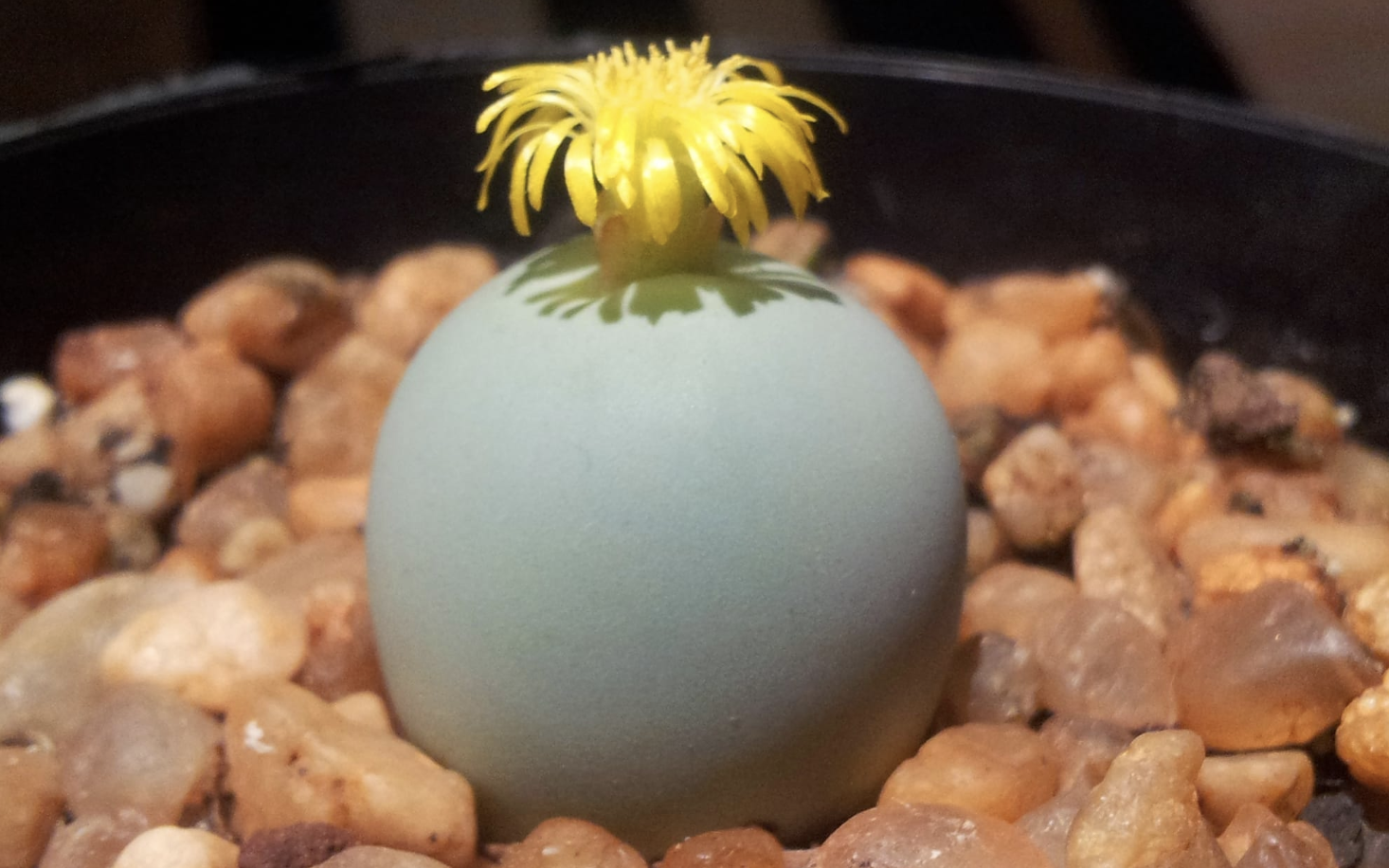
SANBI’s PlantZAfrica account of Conophytum pageae explains that it grows through the cooler, wetter part of the year and rests in summer, when older leaves form protective sheaths around new growth. Its cultivation guidance stresses drainage and protection from prolonged afternoon sun. This is why a tray of small, apparently dry plants needs informed attention.
Multiplied across species and consignments, these differences create a demand for controlled conditions and staff thst understand the plants they're supporting. SANBI’s annual report records efforts to improve matters: assistance from a horticulturist seconded from Ireland for inventory work, training and plant care, as well as expanded greenhouse infrastructure supported by the Cactus and Succulent Society of America.
These are essential interventions that also show how much follows the moment of confiscation.
Why not put them back?
Returning a stolen plant sounds like the obvious solution. Conservation authorities have repeatedly explained why it's not that straightforward.
In a written reply dated 18 October 2024, the Western Cape government told the provincial parliament that intercepted plants often couldn't be traced to their precise collection sites. Many are habitat specialists with highly restricted distributions. There might not be enough knowledge of the conditions needed for successful replanting, and harvesting itself can damage the habitat.
The Succulent Karoo is not an interchangeable expanse of ground. Bruwer’s ENACT report raises another concern: seized plants can carry pathogens that threaten other plants.Incoming living material must be assessed for pests and disease before it joins collections; a plant can seem valuable while also presenting a biosecurity risk.
The Western Cape’s parliamentary reply notes that sites remain vulnerable to renewed poaching. Returning plants to an unsecured locality could expose them to the same threat again.
A nursery can preserve possibilities
Confiscated plants may still contribute to conservation where their immediate return isn't possible.
SANBI’s Succulent Poaching Working Group focuses on genetically diverse collections outside natural habitats and the use of confiscated material as parent stock for producing seed and seedlings. It also proposes exploring restoration and reintroduction where sites can be secured.
These are conservation collections which includes material that might support future recovery.
That said, a collection isn't a substitute for a functioning wild population. Keeping specimens alive protects an option but doesn't restore all the relationships and conditions lost from their original habitat.
What should count as success?
An August 2026 SANBI parliamentary presentation put the national response strategy’s funding requirement for 2025–2030 at R70 million. That is a requirement for the wider strategy, not a nursery budget alone. Seizure totals are important evidence of enforcement activity, but can't reveal how much biodiversity has been protected.
For a confiscated succulent, the decisive work happens after the police have recorded their evidence: the plant still has to have its condition assessed, it must be correctly identified, and its ideal conditions for replanting identified. Until that work is adequately supported, an interception is only the beginning of a rescue whose outcome is still uncertain.


🎶 Laai die playlist hier af. 𝖣𝖾𝗄𝖺𝖽𝖾𝗌 𝗌𝖾 𝗈𝗈𝗋𝗌𝗉𝗋𝗈𝗇𝗄𝗅𝗂𝗄𝖾 𝖠𝖿𝗋𝗂𝗄𝖺𝖺𝗇𝗌𝖾 𝖽𝗂𝗀𝗄𝗎𝗇𝗌 𝗄𝗋𝗒 𝗇𝗎𝗐𝖾 𝗅𝖾𝗐𝖾 𝖽𝖾𝗎𝗋 𝗆𝗎𝗌𝗂𝖾𝗄. 𝖶𝖾𝗅𝗄𝗈𝗆 𝗂𝗇 𝗆𝗒 𝖪𝗅𝖾𝗂𝗇 𝖪𝖺𝗋𝗈𝗈 - 𝖡𝗈𝗅𝖺𝗇𝖽𝗌𝖾 𝖻𝗂𝗇𝗇𝖾𝗄𝖺𝗆𝖾𝗋.
Comments ()