
The strange mixture of conservatism and creativity in the Karoo
The Karoo is still one of South Africa’s most fascinating contradictions. Deeply conservative in many ways, it has also become a powerful centre for creativity, attracting artists, writers and dreamers drawn to its isolation and immense landscapes.
There's an unexpected contradiction at the heart of small-town Karoo life. You notice it first in the churches with their white steeples and old wooden pews, the careful pace of farming life and the way people still greet one another in the street.
The Karoo can feel deeply conservative, holding tightly to its traditions. At the same time, the region produces an unusual number of artists, writers, musicians and dreamers.
There are towns where old farmers still discuss rainfall records from thirty years ago while a sculptor welds giant metal birds together in a backyard nearby. There are strict church communities where children grow up to become photographers or filmmakers. There are people who live modestly while producing extraordinary work behind closed doors.
Karoo culture is built on restraint. Life here has never been easy. Economy is learned in a place of scarce water, brutal summers and bone-crackling winters.
Generations have learned to survive by being practical and careful with resources. At the same time, the Karoo's isolation creates imagination.
People in large cities are constantly distracted, while in the sparse unpeopled reaches of the Karoo one learns to observe. You notice the changing colour of mountains late in the day or the strange stillness before rain arrives. Creative thought grows well in places where there is space enough to hear yourself think.
Many artists who arrive in the Karoo from elsewhere speak to how the landscape strips life down to its essentials while sharpening their perception. Writers finish novels here and painters produce their strongest work. Musicians disappear into small towns for months at a time and emerge with new material.
The irony is that some of these artists settle in places that remain socially conservative. Small Karoo towns can still be cautious of outsiders and wary of change. Gossip moves quickly and communities remember everything. Families often have generations-long histories, so that at first it back generations it may not seem like fertile ground for creativity at all.
A great deal of Karoo art emerges from this collision between old structures and individual expression. The artist in the Karoo is rarely working in a completely liberal or bohemian environment. Instead, they create within disciplined, religious communities of farming tradition and inherited values. That friction gives the work texture and grounds it in practical life.
One sees it clearly in Karoo architecture as well. Old Victorian homes house modern studios and traditional farmhouses contain wildly contemporary paintings. Antique furniture is placed beneath abstract sculptures. The region has developed a visual language where conservatism and experimentation exist side by side without cancelling one another out.
Places like Prince Albert, Nieu-Bethesda and Richmond reveal this mixture particularly well. One finds old agricultural traditions continuing much as they always have while literary festivals, galleries, theatres and artists flourish alongside them.
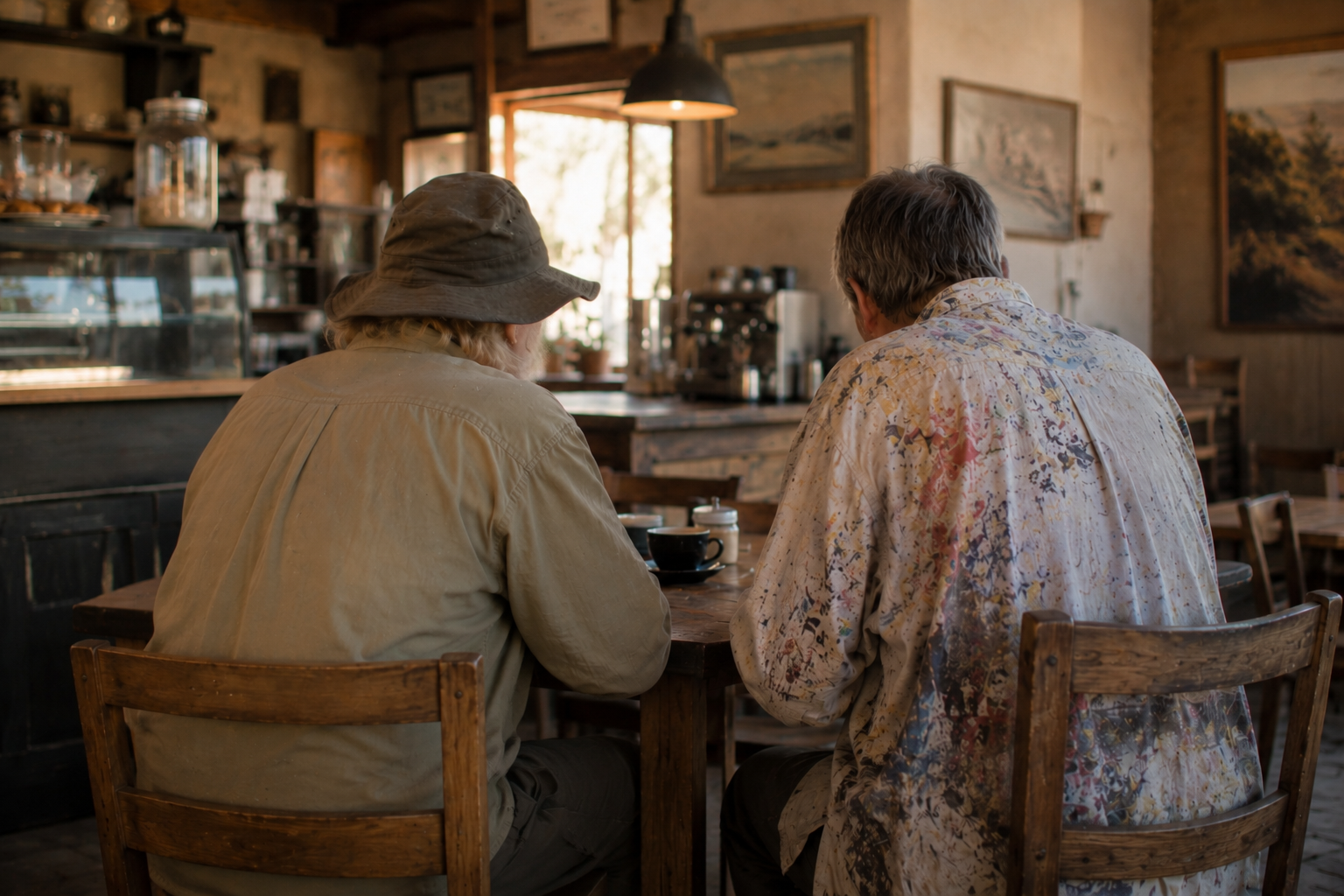
The Karoo has also long attracted people who feel slightly out of place elsewhere. Some arrive after burnout in cities. Others come after divorce, financial collapse or personal reinvention. There are retired professors living beside sheep farmers, painters drinking coffee with mechanics, musicians renting old cottages. The region has become a refuge for people searching for quieter and perhaps more honest ways of living.
Farming is central, church halls host bazaars, and rugby fields still fill on winter Saturdays. The social values remain deeply traditional while the creative undercurrent flows just beneath the surface.
This balance may explain why the Karoo feels so emotionally complex to many South Africans. Existing somewhere between eras, a person can feel both constrained and strangely liberated there.
Ernest Hemingway once wrote that people become more themselves in hard country. The Karoo has always been hard country. That same hardness creates the conditions for creativity to emerge with unusual force. Art made in easier places can sometimes drift into decoration. In the Karoo, creative work often feels tied to survival itself.
This may be why the region continues to fascinate writers and artists generation after generation. Beneath its conservatism lies deep emotional and imaginative life, and the contradictions do not cancel out one another, but feed each other.

Comments ()